Google says local results are mainly based on relevance, distance, and prominence. Reviews, links, articles, directories, and accurate profile information can contribute to those systems, but no single reputation activity controls the result.
Google's three main local factors
| Factor | What it means | Related business work |
|---|---|---|
| Relevance | How well the business matches what the customer is searching for | Accurate categories, services, profile details, and useful website content |
| Distance | How far the business is from the location used for the search | Accurate location or service-area information; the searcher's location remains outside the business's control |
| Prominence | How well known or established the business appears online and offline | Reviews, links, articles, directories, and other public recognition |
Google states that more reviews and positive ratings can help local ranking, while also making clear that there is no way to request or pay for a better local ranking. Review signals sit inside a broader system.
What responsible reputation work can influence
Profile completeness and accuracy
Complete, detailed business information helps Google understand a business's relevance and helps customers make a decision. This includes the correct name, category, location or service area, hours, contact information, services, and website.
Authentic review flow and response practices
A consistent request process can increase the opportunity for recent, first-hand feedback. Responses can show that the business pays attention, but they should be accurate, privacy-conscious, and appropriate to the review.
Listings and public prominence
Accurate industry and local listings, useful articles, legitimate media mentions, and links can strengthen the public information around a business. Listing volume alone is not a useful goal; relevance, accuracy, and legitimacy matter.
Website usefulness
Google notes that a business's position in web results is also a factor in local ranking. Clear service and location pages can help customers and search systems understand the offer, while accessible contact paths help convert attention into a measurable lead.
What reputation management cannot control
- the distance between a searcher and the business;
- which competitors enter or improve in the market;
- Google's algorithms, interface, policy decisions, or review outcomes;
- the rating or wording an independent customer chooses;
- the removal of legitimate criticism; or
- a specific map position, lead count, or revenue result.
Do not add keywords to the business name unless they are part of the real-world name, create ineligible locations, buy reviews, screen out unhappy customers, or ask reviewers to include ranking keywords.
Use a scorecard that separates inputs from outcomes
| Layer | Examples |
|---|---|
| Work completed | Profile fields corrected, priority listings updated, eligible customers invited, reviews answered |
| Signal health | Review recency and distribution, unresolved duplicates, listing accuracy, relevant content coverage |
| Visibility | Search impressions, geographic rank patterns, branded discovery, website search performance |
| Customer actions | Qualified calls, directions, bookings, forms, and completed sales where attribution is reliable |
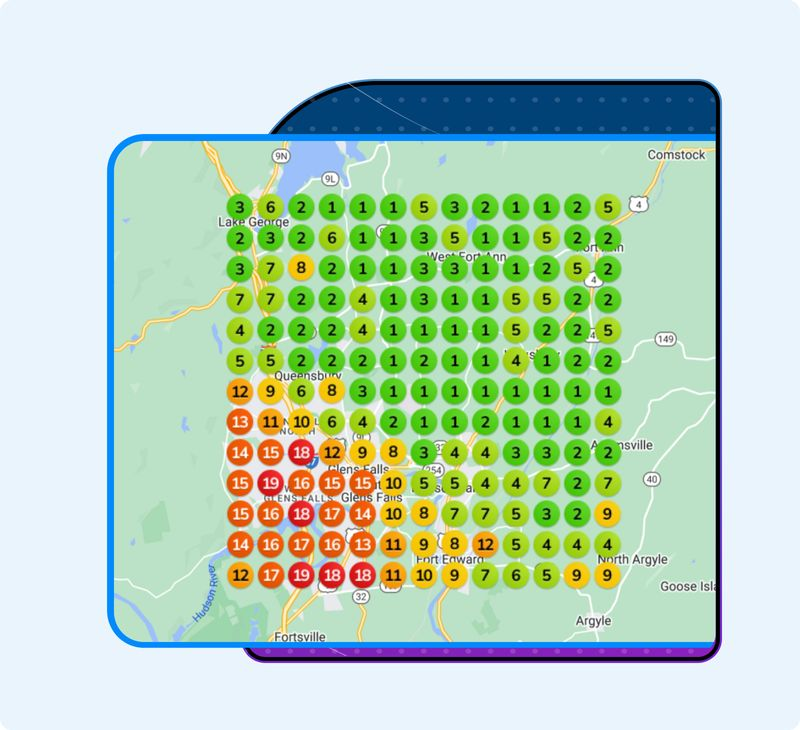
Compare meaningful periods and locations, note concurrent changes, and avoid treating correlation as proof. Geographic heatmaps can reveal patterns, but they are observations from selected points and keywords, not a guarantee of how every person will see the results.